Pages

Tuesday, September 1, 2009

Rare Encounter

  Have you ever had one of those times when you regretted not having your camera on hand? I had one of those moments this past weekend and I’m still kicking myself for not having one with me. I even debated whether or not to post this since I have no, as they say “proof of purchase” to confirm my encounter. Regardless, this is the place to document my exciting discoveries – right? So if you would, just take my word for it and hopefully next time I will have my camera with me!

On Sunday, my daughter and I headed out in my pick-up truck to the local landfill to unload some of the never-ending stuff that seems to collect in the black hole I call a garage (I’m sure some of you can relate). On our exit out of the landfill I approached a car in front of us that was stopped. As I slowed down behind the car something caught my eye. Out from in front of the stopped car came slithering a large snake. Virginia is home to a variety of snakes, many I have encountered before, but this one was unlike any I had come across in the wild. A quick look at its tail verified it for me – a real live, non-captive, Canebrake Rattlesnake (Crotalus horridus)!

I knew these snakes were around but had never encountered one. As a matter of fact, they are listed as endangered here in the state of Virginia. My daughter and I watched the 4-1/2 + foot snake safely from inside our vehicle as it slowly crossed the 2-lane road and disappeared in the grass and wooded area surrounding the roadway. Snakes aren’t on the top of my list of animals I want to encounter, but this one was a sight to behold.

Canebrakes are large, venomous snakes that can grow over 5 feet in length. Males grow larger than females. It has a triangular head and a pit below each eye. The black tail is tipped with a rattle.

Below is a photo of the canebrake rattlesnake taken by the Virginia Department of Game & Inland Fisheries:

030013-1

I felt the encounter was also a good time to remind my little girl not to ever approach a snake in the wild. Here she is holding a captive cornsnake at the 2009 Great Dismal Swamp Birding Festival.

IMG_369211

The canebrake is sometimes referred to as the timber rattlesnake, or vice versa. It was once thought the two were separate species but is now considered to be just another color phase.


Technorati Tags:

Sunday, August 30, 2009

Mockingbirds Don't Forget!

   An interesting new study that came out this spring found that mockingbirds can remember people who have threatened them in the past.

IMG_2444 Northern Mockingbird - photo by Alan Pulley, 2009

The study was lead by Doug Levey, a professor at the University of Florida, showed that mockingbirds ignored most passers, but attacked when they recognized people who had approached their nest just days before.

"Sixty seconds of exposure was all it took for mockingbirds to learn to identify different individuals and pick them out of all other students on campus," Levey said.

Check out the article and video when you get a chance - it's very interesting: http://www.guardian.co.uk/science/2009/may/18/mockingbirds-human-recognition


Wednesday, August 26, 2009

August Sunset - Skywatch Friday

This was the scene in my backyard a few nights ago...


So that from the rising of the sun to the place of its setting men may know there is none besides me. I am the LORD, and there is no other.
Isaiah 45:6 (NIV)


Be sure to visit the Skywatch Friday home page for more great photos.

A Day at the Norfolk Botanical Gardens

IMG_4697

I spent a fun day earlier this week visiting the Norfolk Botanical Gardens. I remember going there once at a young age but haven't been back since. It's about 35 miles from where I live and I've been trying to get back to it for a long time now. Needless to say, my expectations weren't let down.

Norfolk Botanical Garden is nationally recognized for its deep-rooted history and celebrated for its blooms in every season. The 155 acre garden is home to 30 distinctive themed gardens, 95 species of birds and 30 different kinds of butterflies. There's also a 3-acre children's garden where they can explore the connections between plants and the environment.

Here my daughter is intrigued with a tiger swallowtail butterfly.

IMG_4902

The butterfly exhibit was one of the more exciting areas, especially for the kids. This enclosed exhibit was filled with hundreds of butterflies.

Black Swallowtail

IMG_4756

Gulf Fritillary

IMG_4764

The Japanese Garden was another favorite.

IMG_4800

IMG_4793

Norfolk Botanical Gardens has one of the largest, most extensive collections of azaleas, rhododendrons and roses on the East Coast. Unfortunately, I'll have to wait and go back next spring to see them in peak bloom; however, there were plenty of other blooms to explore. The following is some of my favorite photos I took in the gardens.

IMG_4701

IMG_4720

IMG_4849

IMG_4873

A few roses were still looking good...

IMG_4883

IMG_4893

The park was home to some gorgeous crepe myrtles.

IMG_4919

I hope you've enjoyed this brief pictorial tour of the gardens. If you're ever in the area and have a day to spare, swing by Norfolk and visit their botanical gardens - you wont be disappointed.

Technorati Tags:

Monday, August 24, 2009

Hawk ID Presentation

  I wanted to share this  really cool hawk guide, I recently found, created by the Hawk Migration Association of North America (HMANA). This free guide is a PowerPoint presentation that combines photographs of flying raptors, silhouettes and in-flight identification tips to help improve your hawk watching skills. The guide has been out for a few months but I just came across it this past weekend thanks to RGVBirding Fest, who posted it on Twitter.

Here's some screen shots from the presentation guide:

Clipboard01 

Clipboard04

Clipboard05

The free guide is called Identification of Raptors of the Northeast and can be found here: http://hmana.org/read_article.php?id=12

HMANA is a membership-based organization committed to the conservation of raptors. They are the same organization that put out the Silhouette Hawk ID Guide about a year ago.

Like I mentioned, this guide is a Microsoft PowerPoint presentation. If you don't have PowerPoint on your computer you can download PowerPoint Viewer for free. PowerPoint Viewer allows you to view PowerPoint presentations but doesn't allow you to create or modify presentations.


Technorati Tags:

Saturday, August 22, 2009

Mystical Moths

IMG_4002

Isn't this a striking creature?

I'm not sure what species of moth this is. If anyone knows please leave me a comment. I've tried to ID it thru Bug Guide but haven't quite narrowed it down yet.

IMG_4004

In my efforts to make my yard a better habitat for birds, butterflies and bees, I've found that other little creatures tend to tag along as well - like moths.

I've taken a little time here recently to try and familiarize myself with moths and their purpose in the natural world. They are considered a pest to many. Some moth caterpillar species become invasive and can cause extensive damage to plants while others like the clothes moth can cause damage inside a home.

Aside from a few problematic species, moths play an important part in our ecosystem. They are a big part of the food chain, making meals for others like spiders, frogs, bats and birds. Moth larva also serve as a source of food for wildlife. Moths are also important pollinators. Many plants, especially night blooming ones, depend on moths for pollination.

IMG_4651

IMG_4300

Moths ans butterflies are closely related - both being of the order Lepidoptera. Some of the differences between moths and butterflies are fairly obvious if you look closely. Butterflies fly in the daytime, while most moths fly at night. Butterfly antennae are thin and smooth, with small clubs at the end. Moths have a thicker, feathery antennae, without the club on the end. Most moths have thicker bodies as well.

Picture2

The above photo may look like a moth at first glance but if you notice the "clubs" (circled in red) on the end of its antennae, you will see that it's a butterfly.

Another easy way to tell butterfly and moths apart is to watch it land. If it's wings are folded together pointing up, its probably a butterfly. If its wings are folded against its body or pointing out flat from its sides, it's probably a moth.

My daughter has a bug book with a recipe for attracting moths - called "moth sugar". I personally haven't tried this but my daughter and I hope to do this before the summer ends.

Here is the recipe:

Moth Sugar

  • 3 tbs sugar
  • water
  • 2 tbs apple juice
  • 1 quart plastic jug/container
  • old paint brush
  • sponge

(1) Fill jug with water (2) mix sugar and apple juice into the jug of water (3) use the paint brush to brush the "moth sugar" on a rock, stump, fence post or wherever...or soak the sponge in the mixture and hang it up in a tree (4) just after dark, go see if you have any moth visitors!

Have a good weekend everyone!

Camera Critters

Technorati Tags: ,,

Thursday, August 20, 2009

Benefit of Bees

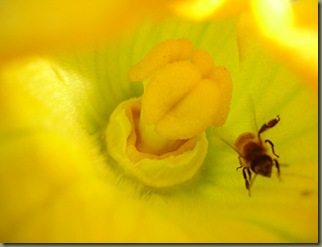
As many know, there’s a lot that goes into managing a vegetable garden. No matter the size, there’s always something to do – like soil prepping, weeding, watering, planting…you get the idea. With all that we do to help improve our chances for success, we’re not the only ones in control. Believe it or not, there are other busy workers out and about giving us a helping hand, and their presence could determine the success or failure of our efforts.

Zucchini-flower-bee

That’s right, I’m talking about bees!

I’ve come to learn that the longer I garden the more I get interested in the little things that help make it all come together. The importance of bees is sometimes under estimated. A close connection exists between the bees and our vegetables. Most of the vegetables and fruits we eat depend on bees for reproduction. Bees are truly a gardener’s friend.

To ensure my veggies like squash and cucumbers get pollinated, I like to add a few flowers throughout the garden to help attract more bees.

BBee

I did a little research on the subject and came up with a few cool facts about bees and pollination:

This from the North American Pollinator Protection Campaign

  • Almost 90 percent of flowering plants must be pollinated by animals.
  • More than 200,000 species – from beetles to bees, from ants to butterflies, from hummingbirds to bats – act as pollinators; but bees pollinate the most plants.
  • Pollinators (mostly bees) are responsible for about 1/3 of the food that we eat
  • Honeybees are not native to the United States. They were brought over by the colonists in the 1600s.

Bee

Want to attract more bees? Here are some tips...

  • Plant more native plants.
  • Bees like herbs. Plant a few of them in the garden and allow some to bloom.
  • Pick plants that will flower throughout the year - even in winter. Bees forage anytime the temperatures are above 50 degrees.
  • Avoid using pesticides whenever possible. If you must spray do it in the evening when bees are less active, and if you can avoid it, don’t spray the bloom itself.
  • Flat flowers are best for bees because they don’t have long proboscises like butterflies do. They don’t like to go down to deep in a flower.
  • Create a drinking area by filling a saucer with wet sand and sinking it into the ground. Keep the sand wet. Puddling areas like this will attract both bees and butterflies.
  • Some recommended plants include goldenrod, yarrow, bee balm, hyssops, salvias, mints, lavender and thyme as well as fruits, like blueberries.

With all the benefits that bees provide, why not provide them a little something extra in your garden.

Reference:

Technorati Tags: ,,