Pages

Thursday, July 1, 2010

Hummingbird Hitches a Ride - Another Local Bird Tale

 Another bird story surfaced in this weeks local paper and its got me convinced that the birds in my city have gone a little "cuckoo" (no pun intended...ha ha).
First was the escaped emu that was roaming the city, now a story just came out about a hummingbird moving to the country. And when I say moving, it's probably not moving in the way you think.
hummingb
It's hard not to get excited about seeing a hummingbird. I see them in my garden all the time and I stop each and every time to watch them zip around my flowers. Their curious nature often makes it possible to get very close to them from time to time. But what recently happened to a local woman takes it to a whole new level.
Below is a brief story as to what happened, but you will have to read the article to appreciate the whole story.
A lady was visiting her mother across town, and for whatever reason a hummingbird took a liking to her. The hummingbird actually landed on the woman's head and at one point licked her face. The hummingbird later entered into the woman's truck when she was ready to drive off.
She named the hummingbird Jake and it traveled with her while she ran errands around town. The hummingbird actually waited outside for the woman while she attended her doctors appointment. The bird ended up going home with her.
Check out the article if you get a chance. It's a must read!
http://www.suffolknewsherald.com/news/2010/jun/28/city-bird-moves-country/

26XBN46MNPAW

Sunday, June 27, 2010

Bee Good to Pollinators

 In case you missed it, this week (June 21st-22nd) was National Pollinator Week. Three years ago the U.S. Senate’s unanimous approval and designation of the final week in June as “National Pollinator Week” marked a necessary step toward addressing the urgent issue of declining pollinator populations. Pollinator Week has grown to be an international celebration of the valuable services provided by bees, birds, butterflies, bats and other insects.
IMG_1670
One of the leading organizations for this cause, and a great resource for all things pollinator related is pollinator.org. Their mission is to protect pollinators, critical to food and ecosystems, through conservation, education, and research. Signature initiatives include the NAPPC (North American Pollinator Protection Campaign), National Pollinator Week, and the regional Planting Guides. Be sure to check out the regional planting guides on their website. Once there, input your zip code and it will give you an informational guide (.pdf) for selecting plants in your area for pollinators along with other useful information about the pollinators in your area. Here is the regional guide for my area: http://www.pollinator.org/OuterCoastal.rx5.pdf
IMG_1704
In addition to planting a variety of pollinator favorites, you can also provide housing for our native pollinators like the orchard mason bee and the leafcutter bee. Here's a photo of my mason bee house.
IMG_6643
IMG_6645a
Mason bees nests in natural holes, creating individual cells for their brood that are separated by mud dividers. Unlike carpenter bees, they cannot drill there own holes in wood. They will often use holes created by carpenter bees or any other small hole or crevice found in nature. They are great pollinators to have around for your garden, and you can help attract them by purchasing or making one of these houses for them.
I put my house up a little late this spring so I haven't had any mason bees in it but it has attracted a few leafcutter bees. Like Mason Bees and just as fascinating, leafcutters have a similar nesting style and will nest in the same wooden bee houses except, as their name suggests, they line their cells with small pieces of leaves instead of mud. Here's a close-up comparison:
mud
Mud sealing - a Mason Bee hole
leafseal1
leaf sealing - a leafcutter Bee hole
Leaf cutter bees are also great pollinators to have around.
Check out these links for more information on our native bees, as well as attracting and constructing housing for them:
Information about solitary bees and attracting them: http://wingsinflight.com/gardbees.html
Managing and instructions on building a mason bee house: http://www.ces.ncsu.edu/depts/ent/notes/Other/note109/note109.html

http://www.nwf.org/Get-Outside/Outdoor-Activities/Garden-for-Wildlife/Gardening-Tips/Build-a-Bee-House.aspx

Great site about native bee conservation: http://www.ournativebees.com/home.html

Also, check out the pollinator page over at the U.S. Fish and Wildlife Service:
http://www.fws.gov/pollinators/

Monday, June 21, 2010

Big Bird on the Loose

 As most of you know, I’m all about attracting wildlife, especially birds, to my yard. It’s always exciting to catch sight of a bird at the feeder that I haven’t seen before. But the bird I saw last week wasn’t one I expected, or better yet, didn’t even think was possible.
I was cutting grass on my riding mower one afternoon last week when something caught my attention. I looked over to my left and what was there didn’t seem real - oh, but it was! It was Emu (Dromaius novaehollandiae). The closest I had ever been to one of these Australian birds was at the VA Zoo, which is at least 30 plus miles away.
emu1
Emus are large flightless birds that reach up to 6-1/2 feet tall. They are native to Australia and are one of the largest birds in the world, second only to the ostrich. Emus forage on a variety of plants, seeds and insects and are capable of traveling long distances in search of food (not good news for the owner still looking for this big bird). In recent years Emu farms, both abroad and here in the U.S. have become very popular. They are farmed primarily for their meat, and sometimes for leather and oil. They are also popular animals to see in petting zoos and hobby farms.
For just a split second, the Emu was coming straight towards me at a hasty trot before veering off to one side. I think the running mower probably startled it a little. I turned the mower off and just stared at it in disbelief for a moment. I knew this wasn’t normal, but I wasn’t aware of an emu farm nearby and wasn’t sure who to call. I continued to watch as the Emu slowed to a casual walk and proceeded across my front yard. At that moment I realized I should document this or possibly be considered crazy for telling everyone what I just witnessed, especially since my wife and daughter were not home at the moment of encounter. As a matter of fact, none of my neighbors where outside to witness this. I was definitely all alone on this one. At that moment I jumped off the mower and went inside to grab my camera. I came back out and was able to snap off a few photos before the emu disappeared down the street.
emu3
My feeling went from disbelief to comical later on when viewing the photos with my family. I’ve attracted many birds to my yard using bird feeders and nest boxes, but without saying, this was definitely the oddest bird I have ever had in my yard.
emu2
A few days later my mother-in-law emailed me an article from the local paper that helped to put the puzzle pieces together. It seems as if several emus escaped from an animal farm in a neighboring city and have been showing up in odd places, one of them being a local golf course. Here’s a link to the article:
http://www.suffolknewsherald.com/news/2010/jun/16/trail-emu/
Just this past weekend another article surfaced in the same news paper. Seems as if one is still on the loose:
http://www.suffolknewsherald.com/news/2010/jun/19/emu-loose/
And just this evening the story made it on our local TV news - hey, this is big news for a small city like Suffolk.


UPDATE: The last emu was captured on Tuesday (6/22) and moved to the VA Zoo. Here's a link to the local article: http://www.suffolknewsherald.com/news/2010/jun/22/emu-captured-moved-zoo/


Be sure to check out other birds this week over at Birdfreak's Bird Photographer Weekly #96

Saturday, June 19, 2010

Great Dismal Swamp 2010 Birding Festival - Better Late than Never

 Okay, so I've gone AWOL for a few weeks and gotten behind on my post again. I guess it happens to the best of us, or worse depending on how you look at it. Now back, I wanted to follow up on our trip to the Great Dismal Swamp for last months birding festival. Better late than never, right?

My daughter and I set out early that morning before the weather got to hot. Our destination was to the Washington Ditch canal were we intended to check out and hike the new boardwalk trail that just opened up to the public.

Upon entrance to the Washington Ditch we were greeted by a couple of whitetail deer browsing along the field edges. I managed to snap a photo before the last one casually disappeared in the thicket.
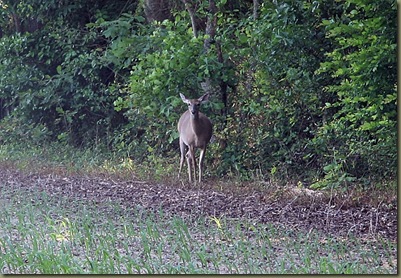
Deer

Here's a look at the entrance of the new boardwalk trail.
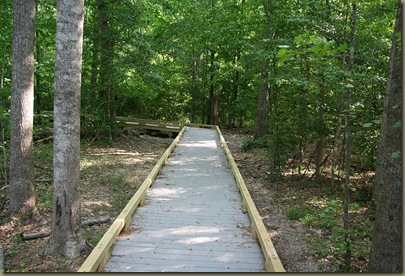
New BWTrail

This new trail winds 3/4 mile deep in and out of the forest. It goes through a variety of habitats found within the swamp. My daughter and I hiked a small portion of it.

Along the trail we saw encountered a lot of familiar native flora. Here's one of my favorites, the coral honeysuckle. It's a favorite of hummingbirds as well.

C Honeysuckle

We stopped along the trail to check out out a variety of birds and other wildlife. Morgan (below) seems to be interested in something above. I think it's wonderful that she shows an early interest in nature and the outdoors. I think it's very important to get children outside as early as possible so that they can learn to appreciate the great outdoors and all it has to offer. If I could only get her over her fear of bugs!

Morgan

After the hike we headed over to the Dismal Swamp headquarters where the main event was taken place. There they had a variety of displays and nature activities set up for kids and adults to learn and enjoy.

Like the previous years of this event, Morgan's favorite display was the snakes. Here she is getting ready to handle her favorite one - its an Corn Snake. Corn snakes are found throughout much of the southeastern and central United States. They're docile snakes that reach approximately 4 to 5 feet in length. Sometimes they are referred to as red rat snakes.

By the way, here's a cool site that list the snakes of Virginia if interested: http://fwie.fw.vt.edu/VHS/reptiles/snakes/snakes_of_virginia.htm
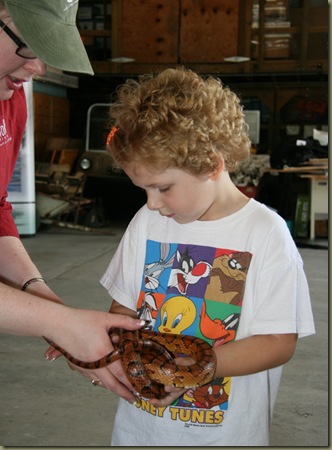
Morgan2

Below she is holding the corn snake by herself. Believe it or not, this is the main reason she enjoys coming to this event each year.
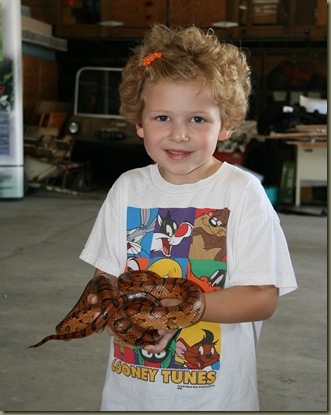
Morgan3

Below she is holding a smaller Mole Kingsnake.

Morgan4

After the snakes we walked over to one of the activity tents where we built a bluebird nest box. Notice how well she hammers. She looks to be taken it very seriously.

Morgan5 

Needless to say we had a great time at the fourth annual Great Dismal Swamp Birding Festival. And if you live in the area, here's a link to the swamps summer calendar of events. There may be something that interest you: http://www.fws.gov/northeast/greatdismalswamp/pdf/summer10.pdf

Wednesday, May 5, 2010

Spring Migration Celebration at the Great Dismal Swamp

  If you live in Virginia or North Carolina, or anywhere in the vicinity this weekend, be sure to come by and attend the fourth annual Great Dismal Swamp Birding Festival. The event starts on Thursday the 6th thru Saturday the 8th. There will be bird banding demonstrations, guided bird and nature walks, workshops, and more. And Saturday will be family fun day that includes children activities, music, food, exhibits and tours. I’ve had a great time in the past at this event and looking forward to it again this year.

Here’s a link to the event brochure with schedules for each event (there all free!). Also, be sure to look at the photos along the top of the second page. My daughter's picture is in there! She is the one holding the snake. It was taken at last years event.

http://www.fws.gov/northeast/greatdismalswamp/pdf/2010%20BF%20program.pdf


Hope to see some of you there!

Sunday, May 2, 2010

Hiding Out

 One of the most territorial birds in my backyard is the Northern Mockingbird. And when they have a nest nearby they seem to turn it up another notch or two. They aggressively harass birds that intrude on their territories, flying towards them  flaunting their bright white wing patches and squawking like mockingbirds do.

I've noticed some of these turf wars going on in the back corner of my property recently and decided (with caution) to take a closer look. I inspected the area for a nest and what I stumbled upon was even better - little fledglings!

These little mockingbirds were hiding out in my elaeagnus shrubs.

IMG_6361

Look closely below and you can see another one buried deep within the shrub.

IMG_6362

Here's another...look closely.

IMG_6364

Needless to say, they were well protected within the shrub and the parents provided another barrier of protection from outside.

IMG_6360

I counted three all together, but there could have been more. I didn't wont to continue stressing mom and dad out or their young. I stepped backed and watched for a while as mom and dad continued to feed them in the shrubs. They will continue to care for their young until they are able to do so for themselves. This is the case with most birds. The parents will continue to feed and watch over their young even after they leave the safety of the nest.

Have a great weekend and be sure to visit Birdfreak's Bird Photography Weekly (#88) to see more bird photos!


Thursday, April 29, 2010

Cuter than a Chickadee - Nest Tube Update

 Five little chickadee eggs equals....

CChickadees eggs

five little chickadee chicks.

CChickadees

So, what's cuter than a chickadee? How about baby chickadees!

These little Carolina chickadees are in my chickadee nest tube I constructed last year. They are about two weeks old now and will be fledging within the next few days (between 16 -19 days).  As a matter of fact, today will be my last time peaking at them because at this age they could fledge prematurely if disturbed too much.

It's been fun watching the parents go back and forth into the nest cavity feeding their babies.

Chickadee1

Both the male and female take part in caring for the young. Carolina chickadees will normally raise just one brood a year. I'm looking forward to seeing the young ones around the yard this summer.

To learn more about Carolina chickadees check out these links:

http://www.sialis.org/cach.htm / http://www.allaboutbirds.org/guide/Carolina_Chickadee/id