Wednesday, May 5, 2010
Spring Migration Celebration at the Great Dismal Swamp
Here’s a link to the event brochure with schedules for each event (there all free!). Also, be sure to look at the photos along the top of the second page. My daughter's picture is in there! She is the one holding the snake. It was taken at last years event.
http://www.fws.gov/northeast/greatdismalswamp/pdf/2010%20BF%20program.pdf
Hope to see some of you there!
Sunday, May 2, 2010
Hiding Out
One of the most territorial birds in my backyard is the Northern Mockingbird. And when they have a nest nearby they seem to turn it up another notch or two. They aggressively harass birds that intrude on their territories, flying towards them flaunting their bright white wing patches and squawking like mockingbirds do.
I've noticed some of these turf wars going on in the back corner of my property recently and decided (with caution) to take a closer look. I inspected the area for a nest and what I stumbled upon was even better - little fledglings!
These little mockingbirds were hiding out in my elaeagnus shrubs.
Look closely below and you can see another one buried deep within the shrub.
Here's another...look closely.
Needless to say, they were well protected within the shrub and the parents provided another barrier of protection from outside.
I counted three all together, but there could have been more. I didn't wont to continue stressing mom and dad out or their young. I stepped backed and watched for a while as mom and dad continued to feed them in the shrubs. They will continue to care for their young until they are able to do so for themselves. This is the case with most birds. The parents will continue to feed and watch over their young even after they leave the safety of the nest.
Have a great weekend and be sure to visit Birdfreak's Bird Photography Weekly (#88) to see more bird photos!
Thursday, April 29, 2010
Cuter than a Chickadee - Nest Tube Update
Five little chickadee eggs equals....
five little chickadee chicks.
So, what's cuter than a chickadee? How about baby chickadees!
These little Carolina chickadees are in my chickadee nest tube I constructed last year. They are about two weeks old now and will be fledging within the next few days (between 16 -19 days). As a matter of fact, today will be my last time peaking at them because at this age they could fledge prematurely if disturbed too much.
It's been fun watching the parents go back and forth into the nest cavity feeding their babies.
Both the male and female take part in caring for the young. Carolina chickadees will normally raise just one brood a year. I'm looking forward to seeing the young ones around the yard this summer.
To learn more about Carolina chickadees check out these links:
http://www.sialis.org/cach.htm / http://www.allaboutbirds.org/guide/Carolina_Chickadee/id
Thursday, April 22, 2010
The Whimbrel Project
The Eastern Shore of Virginia National Wildlife Refuge serves as one of the country's most valuable stop-overs for migratory birds. Located between the Atlantic Ocean and the Chesapeake Bay, this 1,127-acre refuge was established in 1984 for migratory birds and endangered species management. I'm fortunate to live not that far from this prime birding refuge. Sites like these are very important to birds like whimbrels who stop over in the spring to rest and refuel before heading north to their summer grounds.
Whimbrel's (click link to see a photo of the bird) are one of the most wide-ranging shorebirds in the world. One particular whimpel named 'Hope' is helping scientist understand why this particular shore bird is on the decline. I first heard about Hope from an article in my local newspaper and was amazed at how far whimbrels travel in one year - over 14,000 miles...WOW!
Hope was captured last spring on VA Eastern Shore and fitted with a transmitter. This study is designed to identify stop-over sites that are important to whimbrels and make a case for preserving these sites. This is a very important project because whimbrels have been declining in recent years - mostly due to land development.
Hope recently returned to Virginia's Eastern shore where she'll spend a few weeks resting up and eating fiddler crabs. Her next stop will be to her nesting site in western Canada, near Alaska.
What's amazing is the fact that Hope came back to the exact same mudflat where she was caught last year. It's a wonder how they do this. Here's a map that shows Hope's path over the last year:
Map Source: Center for Conservation Biology, ESRI, USGS
Reference: http://snipurl.com/vp65j
Happy Earth Day everyone!
Sunday, April 4, 2010
Easter Eggs
Look at what's arrived just in time for Easter. The warm spring weather has the birds extra active in my area and the nesting season is well underway. Above is a Eastern Bluebird nest in one of my pvc nest boxes. Eastern Bluebirds normally lay between 3 - 6 eggs.
Another early season nester is the Carolina Chickadee. Those who have followed this blog may remember the chickadee nest tube I built last spring. I'm please to report that the pair of chickadees I posted about a couple months back have decided to make it their home. Carolina Chickadees normally lay between 3 - 8 eggs. That's their eggs below.
These may not be traditional Easter eggs, but their still fun to find. Have a great Easter everyone!!
He is not here; he has risen, just as he said... (Matthew 28:6)
Wednesday, March 3, 2010
Bob’s Big Year
I first heard about Bob Ake in the local newspaper earlier this year. I was drawn to his story not just because he enjoys birds, but also because Bob is a local guy from the Hampton Roads area of VA (my hometown). The former ODU professor retired early to follow his passion – BIRDS!
Bob volunteers and counts shorebirds for the for the U.S. Fish and Wildlife Service and can be found almost anywhere along the Chesapeake Bay looking for birds. He received his first field guide in the mid 60s and has been chasing birds ever since. In fact, he was one of the few birders chosen in 2006 by Cornell University to help comb the woods of Arkansas and Florida for the ivory-billed woodpecker. He has helped band birds, works with the Coastal Virginia Wildlife Observatory on hawk watches, and does Christmas bird surveys for the Audubon Society. But Nov. 30 was his last survey for a while. He will devote all of 2010 to counting birds for himself, something he has been planning for a long time.
He is on a mission this year is to see 650 different U.S. birds, more than he’s ever seen in a single year. When birders set out to see as many birds as possible within 12 months, it’s called a Big Year.
Bob sat down with the American Birding Association lists of 957 bird species endemic to North America and began figuring out his itinerary. He will travel all across the United States this year with a goal of spotting two-thirds of the birds from that list.
Bob didn't waste any time – he started his quest on January one and was up to 116 species in just the first few days. The total to this point stands at 386. He’s well on his way!
If interested, check out Bob Ake’s blog to track his progress: http://bobsbirds.blogspot.com/. He post regular updates with photos of his Big Year adventure. I hope you find his story and blog as interesting as I have. To read this complete article follow this link: http://snipurl.com/umgxe
STEVE EARLEY PHOTOS | THE VIRGINIAN-PILOT
Reference Info: Virginian Pilot; Jan 10, 2010; Magazine; page E1; “Day 1: 82 down. 568 to go”; by Diane Tennant
Friday, February 26, 2010
Spring Cleaning the Chickadee Way
As most can attest, it’s very satisfying when you get something accomplished, and even more satisfying when it works the way it’s intended to. However, when it deals with nature there's no guarantee things will go as planned, but when it does, it makes it all the more worth while.
That’s what happened recently with the chickadee nest tube project I built last spring. If you are a follower you may remember the post titled “DIY Chickadee Nest Tube”. Unfortunately there were no takers last year – probably because I got it up a little to late in the spring. Or, maybe the declining housing market had something to do with it (just kidding about that last part).
It’s still early, but there’s reason to believe that this spring (if it ever gets here) is going to be different. The short warm spell that teased us last weekend got everyone in the spring cleaning mode. Including these little Carolina Chickadees.
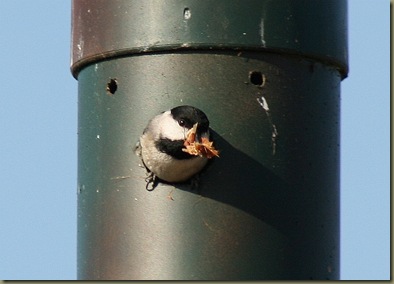
To my surprise, a pair of Carolina Chickadees spent all weekend cleaning out the PVC nest tube. Each were taking turns removing the wood shavings from the nest cavity. Studies indicate that chickadees prefer to nest in cavities they excavate themselves; so I filled the cavity with loose wood shavings prior to putting up.
The shavings kept them occupied most of the weekend, flying in and out with beak full of wood, landing in a nearby tree and dropping them to the ground.
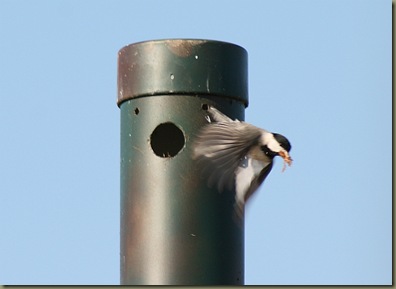
Chickadees are a fun to watch. They're one of the most bravest and curious of the backyard birds. They often seem tame at times.
They've slowed up a bit on their nesting activities now that the weather has cooled off again, but hopefully they'll resume their spring cleaning activities soon.
If interested in building your own chickadee nest tube follow the link below to learn how:
http://www.birds.cornell.edu/Publications/Birdscope/Winter2009/chickadee_tube.html
Be sure to visit Birdfreak's BPW #79 to see more bird photos!
