Tuesday, October 26, 2010
Bird Chow Challenge Contest
I’m currently going through my photos to see what I may have for submittal. I’m finding a few photos captured by my Wingscape BirdCam that may work. That’s the great thing about this cam, just set it up and walk away.
Here’s a BirdCam captured photo of a curious Red-Bellied Woodpecker eating at my peanut feeder.
Here’s another photo courtesy of BirdCam of a momma Eastern Blue Bird feeding her young. Both of these photos were taken last summer.
It’s simple to enter, just go to the link below and follow the instructions. Be sure to have your entries in by Monday, November 1st to qualify. There’s lots of cool prizes being offered.
http://www.birds.cornell.edu/celebration/challenge/bird-chow/take-the-bird-chow-challenge
Have a look at some of the entries received so far: http://www.birds.cornell.edu/celebration/challenge/bird-chow/Bird%20Chow%20Entries/1-24
Sunday, October 24, 2010
Another Year Older and a New Bird Feeder
This past week I turned another year older. Forty-one years to be exact. Each year seems to go by faster than the last. I remember when older adults used to tell me to slow down and enjoy your youth because it will pass by before you know it. I definitely understand that now - not that being in your forties is that old... Oh well, I guess we're never to old to received birthday gifts, right? I look at them as a way to help ease the pain of growing older.
My wife and daughter gave me a wonderful gift from one of my favorite stores: Wild Bird Unlimited (WBU). It was a new hopper bird feeder; but not like any other feeder, it's the EcoTough Classic Feeder. The Eco feeders are a line of feeders sold by WBU that are environmentally friendly and made of recycled plastic. It's a wood-free feeder that actually looks like real wood. These feeders won't crack, fade or rot and carries with it a lifetime guarantee. As with any good quality product, the price is a bit high but it's hard to beat the lifetime guarantee.
Hopper bird feeders look similar in shape to a bird house but offer feeding areas on either side of them while food storage is contained in the center housing. It attracts a wide range of birds. I've gone through several of these feeders in my "short" lifetime that were made of various wood materials, and some were good quality ones, but over time the wood ones just don't hold up in the weather.
While this probably wont be the last bird feeder I purchase it hopefully will be the last hopper feeder that I have to buy.
After taking down the old and putting up the new I decided to dust off my Wingscapes BirdCam to see which birds would be the first to visit the new feeder.
As I expected, the house finches were the first to arrive. Lots of these birds in my backyard this time of year.
Here are a couple of female house finches posing for the camera.
Here's a neat photo. The male house finch just left his perch and looks like he is just floating in air.
It wasn't long before the Northern Cardinals found their way to the new feeder.
If you're thinking about feeding birds in your yard the best feeder to start with, in my opinion, would be a hopper feeder filled with black-oiled sunflower seed. Black-oil sunflower seed is the most popular choice of seed eating birds and will attract the largest variety of birds. I normally alternate my feeders with sunflower and safflower seed, sometimes mixing the two.
BirdFreak blog host Bird Photography Weekly every Sunday. Be sure to stop by their to see more interesting bird photos - and post yours there too!
Sunday, October 3, 2010
Shorebird Season
Late summer and fall are the peak season for viewing shorebirds in many parts of North America. Many species that breed in North America journey from their arctic nesting grounds to winter here in the United States and all the way into South America, and then return to the Arctic the following spring. Some travel more than 15,000 miles in this annual circuit. Remember the whimbrel project?
A few weeks ago I got the opportunity to photograph a few of these birds along the coast of North Carolina. Here are just a few I encountered.
...like the the Semipalmated Plover. They breed along the sandy beaches of the tundra and winter along coastal California and the Carolinas south.
The word in their name "semipalmate" means having the front three toes partly webbed.
Look closely at this next photo and you can see the webbing between it's toes. (click the photo to enlarge)
Up next is the Ruddy Turnstone.
Ruddy Turnstones breed on coastal tundra in northwest Alaska and other islands of the Arctic. They winter in various areas along the US coast (east and west).
Another winter visitor is the Willet. Willets breed from central Canada to Northern California and winter further south along our coastlines.
Here they are feeding on some type of sand crab. A favorite food for may shorebirds.
Sanderlings are also popular here this time of year.
Sanderlings are long-distance migrants from the arctic. They often form in large flocks along mudflats and beaches. They are fun to watch as they are constantly bickering with each other.
If given the chance, get out and see what shore birds may be wintering in your area.
BirdFreak blog host Bird Photography Weekly on Sundays. Be sure to stop by their to see more interesting bird photos - and post yours there too!
Tuesday, September 21, 2010
Wednesday, September 15, 2010
A New Beginning - September Bloom Day
…like the bluebeard (Caryopteris). The wispy bunches of flowers develop along the stems in late summer to early fall. The silvery foliage also adds a little extra contrast to the landscape.
Pollinators also appreciate these late summer blooms.
Pineapple sage (Salvia elegans) is another late bloomer. It’s well liked by hummingbirds and offers them some late season nectar prior to their migration – when they need it the most.
The combo of the bluebeard and sage planted together adds a big splash in the garden…
A tough little annual that fits in almost any garden is the ‘Diamond Frost’ Euphorbia. It’s very popular in containers, but don’t limit it to just pots. It does great in the landscape as well, offering continuous blooming clouds of airy white flowers. It looks delicate but don’t let that fool you. ‘Diamond Frost’ requires no dead heading and can tolerate heat and drought. Its mounded habit makes for a great border or fill-in plant.
One of my favorite shrubs in the garden this time of year is the American beautyberry (Callicarpa americana). It’s a native woodland shrub that adapts well to the landscape. It blends in the garden hardly noticed until it’s bright lavender berry clusters begin to appear, quickly becoming the star of the garden.
Wednesday, September 8, 2010
Upcoming Fall Events
Fall is my favorite time of the year. The air is cooler, the leaves are changing and migrating birds are on the move again. There’s lots going on this time of year especially if you love being outdoors. It’s also a great time to catch an event or fall festival in your area. There are several in my area related to birding in some way, shape or form that I’m hoping to attend, and hopefully some of you will too.
Currituck Wildlife Festival
First is the 2010 Currituck Wildlife Festival. It’s this weekend – September 11 & 12th. This event host Local and National Decoy Carvers, Wildlife Painters and Exhibitors, Antique Decoy Collections, and more. The event is located at the Currituck County High School in Barco, NC. I’ve participated in this event in prior years so I can say with confidence that it's a great show. Some of the most talented artist on the east coast are a part of this event.
-----------------------------------------------------------------------------
Eastern Shore Birding and Wildlife Festival
Another event taken place in October is the 18th Annual Eastern Shore Birding and Wildlife Festival.
The Eastern Shore of Virginia is a rest stop for many migrating birds, and offers some of the best birding around. You can register and get more information about this event from their website.
-----------------------------------------------------------------------------
Wings Over Water Wildlife Festival
One event that I’m definitely attending this fall is the 14th Annual Wings Over Water Wildlife Festival located on the Outer Banks of North Carolina.
"Annually in November, all the stops are pulled out for folks who come from across the country to participate in the Wings Over Water Wildlife Festival. The six day event celebrates the natural wonders of the area and offers many opportunities to explore and discover the richness of the regions environment."
And if it couldn't get any better, Bill Thompson, III, editor of Bird Watcher's Digest, is this years keynote speaker. Check out their website above to get a listing of events and details on registering.
----------------------------------------------------------------------------
Virginia Wildlife Photography Contest
If you’re a Virginia photographer or happen to have some great photos you've taken in Virginia, you may want to enter them in the 2010 Virginia Wildlife Photography Contest. Deadline for entry is November 2nd. Lots of categories and prizes! Check out the link above for more info.
----------------------------------------------------------------------------
Another big event this fall was recently brought to my attention by a reader asking me to help spread the word – so I will...
A BIRDING ADVENTURE IN CENTRAL PARK
Fall Bird Walks Led by Experts from
the American Museum of Natural History
Fall Bird Walks in Central Park Observe more than 50 different species of birds—including resident and migrant birds, water birds, song birds, and birds of prey— during this eight-week bird-watching adventure in Central Park. Join naturalists Stephen C. Quinn (Tuesdays and Fridays), Joseph DiCostanzo (Wednesdays and Thursdays, 7 am), and Harold Feinberg (Thursdays, 9 am) on tours through the park, one of the premier places locally to watch birds during spring and fall migrations. Participants will learn how to use field marks, habitat, behavior, and song as aids in identification. Interested birders, from beginners to the advanced, are invited.
WHEN: Eight Tuesdays: Sept 7–Oct 26, 7–9 am
Eight Wednesdays: Sept 8–Oct 27, 7–9 am
Eight Thursdays: Sept 9–Oct 28, 7–9 am
Eight Thursdays: Sept 9–Oct 28, 9–11 am
Eight Fridays: Sept 10–Oct 29, 7–9 am
WHERE: Walks start across from the Museum on the northeast corner of Central Park West and 77th Street.
ADMISSION: $85
URL: http://www.amnh.org/programs/programs.php?date=2010-09-08&event_id=1772
FOLLOW: Find the Museum on Facebook at facebook.com/naturalhistory <http://facebook.com/naturalhistory> or visit twitter.com/AMNH <http://www.twitter.com/AMNH> to follow us on Twitter.
Wednesday, September 1, 2010
Playing with Snakes at Hoffler Creek Wildlife Preserve
This particular day they were offering a 2-hour program about snakes geared for both kids and adults. My daughter really loves animals and believe it or not, really digs snakes. If you remember in previous post, the snake display at the annual Great Dismal Swamp Birding Festival is her favorite each year. Here she is a couple years ago at the event holding one of the snakes. You can read about her snake handling here, here and here.
I have taught her that not all snakes are equal, and not to ever approach a snake in the wild.
Saturdays presentation was put on by JB Rattles. JB is a local reptile expert that travels around the area sharing his experiences about some of the world’s most misunderstood animals. The presentation kept everyone on the edge of their seats while JB explained some of the facts and myths about snakes.
Here’s my daughter touching one of the many snakes JB brought out that day. This one is a black rat snake.
The black rat snake is the one you’re most likely to run into around your house. They are very common in this area and are one of the best predators for keeping mice and rats under control. Although they can grow quite large and seem intimidating, it’s a myth that they will chase you. And that goes for any snake. If ever one comes toward you, it was probably scared in that direction – just step out of the way.
Black rat snakes are resilient climbers and can climb vertically on rough surfaces as demonstrated below.
Here’s the black rat ascending a brick wall:
Same snake going up a pine tree:
We learned some other interesting things about snakes - like some of the differences between venomous and non-venomous snakes. For instance, I didn’t know that one way to tell the difference between the two types was the markings on the underside of the snakes tail. Notice in the chart below that the non-venomous snake scales will divide into 2 rows after it passes the anal plate. The other one has a single row of scales, this would mean it is a venomous snake. This rule applies to all native US snakes.
Knowing this is nice, but you won’t catch me picking up a snake to find out! However, if your lucky enough to find a snake skin still in tack you would be able to tell using this method.
There are three venomous snakes in our area of Virginia, and all three of these snakes were present.
Shown below is the most common venomous snake in our region - the Northern Copperhead.
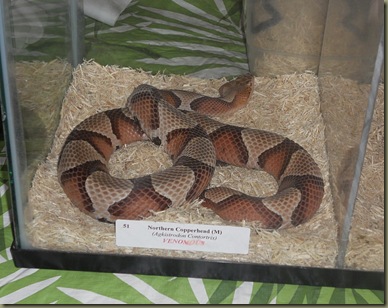
Here JB demonstrates how peaceful these animals can be.
While snakes do not go after people, you must treat them with respect when encountering one in the wild. If cornered or surprised they will bite; however, a majority of snake bites are preventable.
JB stressed the importance of taking action if ever bitten by a poisonous snake. Get to a doctor or hospital immediately and do not attempt to administer first aid yourself. This could make the situation worse. In most cases, adults bitten by a poisonous snake in this region will be okay, but don’t chance it, get to a doctor - especially if a child is involved.
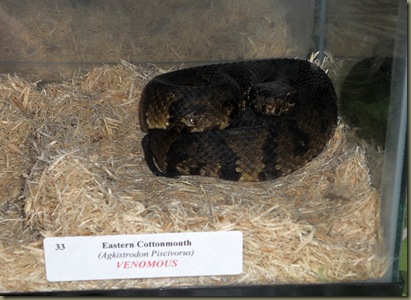
Here's another venomous snake - eastern cottonmouth. These are mostly found in or around water.
Here's a canebrake rattlesnake:
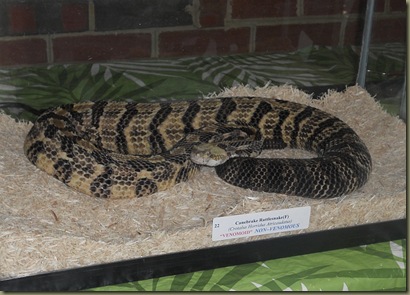
The canebrake is an endangered species. It's decline is mostly due to habitat loss. You may remember my rare encounter with one last fall.
JB brought a variety of other snakes that’s not local to the area, or country for that matter. Like this monacled cobra:
This guy was a little nervous. Notice how his head's faired up.
Check out this 13-foot burmese python!
Here's JB holding a ruthven’s kingsnake (non-venomous):
This snake closely resembles the highly venomous coral snake. To tell the difference remember the saying - "Red touching yellow, snake killing fella. Red touching black, no venom sack."
We often use the word poison and venom interchangeably, often referring to snakes as poisonous. But really thats's not correct - its venomous snakes, and there's a difference. Poison is absorbed or ingested. Venom, on the other hand, is injected into the bloodstream. Unlike poison, some say you could drink venom and it won’t hurt you. Only when it's injected is it effective. I'll just take their word for it.
I hope you enjoyed this brief overview of this fun and informative event. Thanks to Hoffler Creek WP for sponsoring this event and to Les over at A Tidewater Gardener for making me aware of it.
This post has been submitted to this weeks Camera Critters Meme - #126. Be sure to check it out!


